
| Region | |
|---|---|
| Subregion | U.S.A. > California |
| Colour | Red |
| Type | Still |
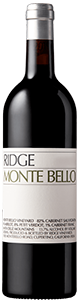
Full bottle 1,312 g. Organically grown estate fruit from one of California's most famous vineyards in a vintage made notorious by the wildfires further north: 84% Cabernet Sauvignon, 11% Merlot, 4% Petit Verdot and 1% Cabernet Franc. Just 76.4 tons from 66 acres because of rain during flowering – after a mild spring – and summer fog. 36 of 58 lots were selected and blended before ageing in barrel for another 12 months. Bottled June 2022.
Deep lustrous crimson. Very complex balsam, sage and ripe Cabernet, including blackcurrant leaf, on the nose. Extremely subtle and layered. Quite marked acidity on palate entry and then supple tannins enclose the fruit. Definitely worth stashing away for many a long year but nowhere near ready. If it has a fault, it's that it lacks a very long finish
Unfortunately, the 2020 Monte Bello is a victim of this harvest's devastating wildfires. Smoke taint is evident from the first pour, after which it receded and then reappeared on and off over the two days I spent with the bottles. The palate tells the same story, with the retronasal signature of campfire smoke and hollowed-out, gritty fruit on the finish. This was only more glaring in the context of a vertical spanning 2021-2015, many of which are banner vintages for Ridge. While an otherwise technically well-made wine is there behind the smoke, albeit with noticeably less depth and concentration than is typical, due to Ridge's decision to bulk out of 90% of the pressed wine, this flaw is unavoidable. In the interest of thoroughness, a sample of the bottled 2020 Monte Bello was submitted to ETS Laboratories in St. Helena, where a series of tests to detect glycosylated smoke markers were carried out (glycosylated tests specifically separate sugar-bound markers from volatile markers that can be imparted by oak élevage). The results confirmed significantly elevated levels of 4-methylguaiacol rutinoside, cresol rutinoside, phenol rutinoside and syringol gentiobioside, all of which correspond to elevated levels of smoke exposure and heightened sensory thresholds by up to a factor of four from the 99th percentile of a non-smoke-affected vintage.