
| Region | |
|---|---|
| Subregion | France > Rhône > Northern Rhône > Côte Rotie |
| Colour | Red |
| Type | Still |
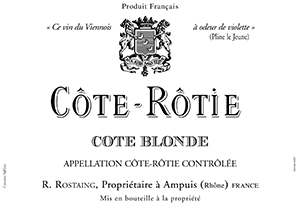
Seventy percent of the stems were utilized in the 2003 Cote Rotie Cote Blonde. This profound Cote Rotie boasts an exquisite nose of bacon fat, sweet black cherry jam, raspberries, melted licorice, chocolate, and hints of herbes de Provence, licorice, and smoke. Voluptuous and full-bodied, it is ideal for drinking now and over the next 10-12 years.
Dee p red-ruby. Blackberry, truffle, bacon fat, coffee and black pepper on the wild nose; a bit less extravagant and more sophisticated today than the Landonne. Dense and large-scaled but more reserved than the Landonne, despite its generosity of texture and sucrosite This, too, is carrying alcohol near 14%, but it comes across as more sappy than the Landonne (the Landonne has a pH near 3. 9, while this is between 3. 8 and 3. 85, with alcohol around 14%). Finishes with huge but very fine tannins and great persistence. Today, this conveys a stronger impression of terroir than Rostaing's other 2003s. Again, Rostaing wondered out loud if this and the Landonne are "typical" Cote-Roties, but they are undeniably impressive. "In 1999, we were shocked by the ripeness of our fruit, but we're now getting used to the warmer climate," Rostaing admitted.
Again a bit reduced but sleek and savoury - a rather welcome change from the typical, rather sweet 2003.Drink 2007-2017.Date tasted 24th Nov 04
A touch of Viognier (3-4%) is co-fermented with the Syrah component in the 2003 Cote Rotie Cote Blonde. An extraordinary perfume of raspberries, blackberries, smoke, violets, lychee nuts, and peaches soars from the glass of this saturated purple-hued offering. Enormously opulent/voluptuous, with dense fruit, abundant glycerin, high tannin, and an amazing finish, this full-bodied, multidimensional 2003 Cote Rotie will flirt with perfection. Anticipated maturity: 2007-2018.
Rostaing told me that in 2003 he only produced 40% of his normal crop, and even more bizarre, he began the harvest on August 21st. Virtually everything in his cellar is over 14% alcohol. One of France’s top sources of Cote Rotie, Rostaing’s intelligent policy about upbringing in both barrels and demi-muids as well as his flexibility about racking and filtration reflect his meticulousness at all stages of winemaking. He did refuse to acidify in 2003 despite extremely low levels of acidity and high pH’s, but he said that actual acidities seemed to go up at the end of fermentation since there seemed to be more acid trapped in the interior of the grapes than in the skins. This is a great vintage for Rostaing, even more exotic and richer than his 1999s.
P.S. By the way, if you cannot afford or find Rostaing’s Cote Roties, he owns 30 acres of vineyards in the Coteaux du Languedoc and his soft, fleshy 2003 Pech-Chaud (a blend of 95% Syrah and 5% Grenache) is very Cote Rotie-like. It is ideal for drinking during its first 3-4 years of life.
Rostaing’s importer status is not yet settled.