
| Region | |
|---|---|
| Subregion | France > Bordeaux > Left Bank > Pauillac |
| Colour | Red |
| Type | Still |
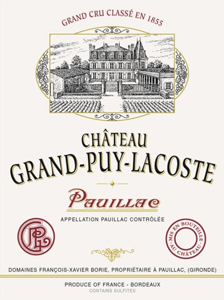

The 2014 Grand-Puy-Lacoste is one of my favorite wines from the Left Bank in this vintage. Bright and vivacious blackberry, cedar and graphite scents soar from the glass with real purpose. Wonderful delineation. The palate is medium-bodied with fine tannins, quite tensile with ample depth. It has matured since I last tasted it four years ago. It is very fresh and has a saline finish. Recommended.
This red shows lots of redcurrants and fresh flowers on the nose. It’s full-bodied with juicy tannins and a long, flavorful finish. Needs three or four years to resolve some of the tannins. Beautiful cabernet character, but already a joy to taste.
Tasted blind. Rather elegant. Not flashy and not that concentrated but beautifully balanced. Already showing its charms even though the medium body and medium charge of tannins should preserve it for a good long life.
Drink 2024-2044
Xavier Borie consistently makes one of the finest and most classic of all Pauillacs here. Frequently GPL is a match for the top names of Pauillac but is usually cheaper en primeur. Much of the fruit is used to make the second wine - Lacoste Borie. A very popular Chateau at Farr Vintners. 82% Cabernet Sauvignon, 18% Merlot this year, with the Cabernet Franc all in the second wine. 75% new oak, with a yield of 33hl/ha. Deep purple colour. Blackcurrant, fresh mint, camphor and sweet vanilla on the nose. Classic Medocain style. Precise, with good freshness. There is good intensity to the cool black fruit on the palate. A very classic style with lots of freshness, cedary Medocain tannins, light toast and spice, and pure blackcurrant flavour. Spice and toast from oak builds on the finish. Excellent Grand Puy Lacoste typicity.
A sleek, graphite-fueled version, with ample cassis and black cherry fruit racing along, picking up light tobacco, anise and bramble notes along the way. The fruit is vivid, presenting pleasant coiled-up energy. Should age nicely. Best from 2020 through 2030. 10,000 cases made.
The nose has a strong black fruit character the start of the palate quite light and fresh. Sweeter and richer in the middle black cherry and cassis but the fresh fruit at the back lightens and balances and bring out fragrances on the finish. 2026-36
The Borie family told me that they are a little exasperated that I keep talking about the value that this Pauillac fifth growth offers, to the exclusion of its other qualities, but it's true. This is a very feminine Pauillac, all grace and poise rather than muscle, with silky perfume and impressive depth of flavour.
The 2014 Grand-Puy Lacoste has a bouquet with blackberry, boysenberry, mint and graphite, well defined and focused. It does not have to try too hard to give so much pleasure. The palate is medium-bodied with fine tannin, very crisp acidity, beautifully proportioned with a veneer of top quality new oak that will need three or four years to be fully subsumed. But the purity and elegance of this Pauillac cannot be denied – a quite brilliant contribution to the 2014 vintage. Tasted blind at the annual Southwold tasting. 2022 - 2050
The 2014 Grand-Puy-Lacoste has a much more approachable nose than usual, vibrant with red cherries, wild strawberry and cedar aromas, backed up with mineral-soaked blackberry fruit. This gathers momentum wonderfully in the glass. The palate is medium-bodied with fine tannin. The acidity is very well judged with purity and elegance on the finish, if not the structure or backbone commonly found is very top vintages. I've been a bit conservative with my score at the moment, but I am sure it will prove its worth with 3-5 more years in bottle, hence the plus sign. One to watch. Drink 2022-2050
The Château Grand Puy Lacoste 2014 is a blend of 82% Cabernet Sauvignon and 18% Merlot between 25 September and 9 October at 33 hectoliter per hectare. The aromatics are not as immediate as the Haut-Batailley and demand more coaxing from the glass, but that comes with the territory. It unfurls with each swirl, black fruits at first, then GPL’s trademark, graphite and gravel scents storm into the room. Leaving the glass aside for 10 minutes there is a distant tang of shucked oyster shells. The palate is understated on the entry. This is not a powerhouse Grand-Puy-Lacoste, rather one that emphasizes finesse and precision. It is almost unerringly low-key and yet there is an enormous length already in place. As usual, I suspect that its secrets (or at least some of them) will be unlocked during its barrel maturation. One of the appellation's most cerebral offerings. Drink: 2020-2045.
This is a wine with a dense center, wonderful fruit, polished and refined tannins and a persistent finish. Full-bodied, long and intense. Beautiful pure cabernet character. Real wine. 82% cabernet sauvignon and 18% merlot. Higher percentage of cabernet than normal.
A bit richer than the Haut-Batailley. Something floral on the nose. Polished and straightforward though a little denser and longer term than its stablemate Haut Batailley. Very round and a sort of cross between Pauillac and Pomerol. In fact many of these Pauillacs are richer than many of the Pomerols in 2014. Very solid. Needs lots of time with all that tannin but very honest and a little more refined than the Pontet-Canet. Great minerally finish and lovely purity. Drink 2025-2040 17++