
| Region | |
|---|---|
| Subregion | France > Bordeaux > Left Bank > Pauillac |
| Colour | Red |
| Type | Still |
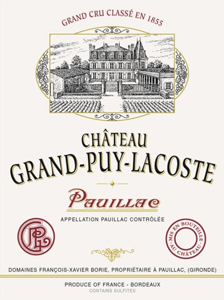

Performing better from bottle than it did from cask (and comparable to their wines 2005, 2000, 1990 and 1982), this is a great classic from Xavier Borie's estate situated on the back roads west of the town of Pauillac. Its dense ruby/purple color is followed by hints of spring flowers, crushed rocks, black currants, cedar and earth/underbrush. Precise and elegant as well as backward and foreboding, it should put on weight in the bottle and evolve for two decades. Very concentrated as well as velvety-textured, it is a beauty of finesse, balance, purity and nobility. It will benefit from 5-7 more years of bottle age.
The 2009 Grand Puy Lacoste is one of the great vintages from this estate in the modern era. It storms from the glass with scents of blackberry, undergrowth, cedar and mint, retaining the classicism of GPL. The palate is medium-bodied with supple tannin, a fine bead of acidity. Very harmonious with a gorgeous, lithe, graphite infused finish that lingers in the mouth. Bon vin. 2022 - 2040.
A sophisticated take on the vintage, 2009 GPL marries rich black fruit with Médocain freshness in what is a terrific success for the property in this excellent year. Still a deep ruby colour in the glass, the nose leads with blackcurrant and spiced black cherry, together with subtle, fragrant baking spices, cedar and dried fruit. The palate is succulent on entry, the tannins present but polished and integrated into the wine. Lightly chalky and generous in fruit intensity, it is ripe but never heavy, retaining its Pauillac backbone and a background acid freshness. Layers of dark fruit, leather, incense and nutmeg all come through, this is gaining complexity as it hits a first plâteau of maturity. A sumptuous but serious wine, it should age gracefully for at least two more decades, though it is hard to resist now.
Complex and decadent. Blackberries and black currants, with fresh herbs on the nose. Tea too. Full body, with soft tannins and an earthy finish. Juicy wine. Turns to pure black currants. Best in 2018.
Medium to deep garnet in color, the 2009 Grand-Puy-Lacoste opens with a nose of sweaty leather, damp earth, baked cherries and dried mulberries with touches of fried herbs, black olives and cast iron pan. Medium-bodied, firm and chewy, this is a more elegantly styled 2009 with provocative herbal sparks and a ferrous finish. Drink 2019-2036.
I could have picked a first growth here – Pauillac has three – but this is a relatively good value fifth growth, making it accessible to more wine lovers, yet with so much signature Pauillac in its structure and flavours of pencil lead, liquorice, cassis and mint. On deep gravel terroir that’s made for Cabernet Sauvignon, and family owned by François-Xavier Borie and his daughter Emeline. Typically you wait for 10 years before opening classified Pauillac, or even longer in very structured vintages such as 2010 – but 2009 was a warm, generous year and is tasting great already. 2021-2042.
Tasted blind. Light nose. Very sweet start. Herbal and interesting. Lots of fine tannin and savour. Very distinctive and ambitious. Slight saltiness. Massive. Long. GV
Drink 2022-2044
Xavier Borie consistently makes one of the finest of all Pauillacs here. Now that he has left Ducru Beaucaillou to the care of his brother, he has more time to devote to this fine property which, in top vintages such as 1982, 1990, 1996, 2000 and 2005 has regularly produced quite magnificent wines. Frequently a match for the top names of Pauillac but usually cheaper en primeur. An extremely reliable property that the canny buyer should consider every year. Much of the fruit is used to make the second wine - Lacoste Borie. This year it has a beautifully defined pure blackcurrant nose. Finely textured, elegant and refined. Smooth tannins, intense yet approachable, supremely elegant and classy. The essence of Pauillac and extremely sophisticated, almost under-stated. A gentleman's claret with great breeding and class.
I loved the 2009, and like most 2009s, it has a ripe, sexy, yet still classic style that's evolving gracefully, with ample darker currant and black cherry fruits as well as tobacco leaf, cedar pencil, truffly earth, and spice box-like nuances. Rich, medium to full-bodied, and concentrated on the palate, with plenty of mid-palate depth and tannins, it's going to continue drinking brilliantly for another two decades. It needs an hour in a decanter if drinking any time soon. 2021-2041.
Violets and wood smoke are very much to the fore on the nose backed by a mix of bilberry and black cherry. The palate has the richness of ripe fruit, the fleshy power well balanced by fresher fruits. Although the tannins are ripe they do give structure the power balanced by freshness giving a feeling of sleekness and elegance. Drink 2018-2040.
A very impressive Pauillac that won't require you taking out a second mortgage to buy a case, this is deeply coloured and profound. Big and boldly structured, but not over-done. Very Cabernet in style, with lovely richness and concentration, fresh acidity and polished tannins. The decision to use less Merlot than usual is vindicated by what's in the glass. 10+ years.
Black red, big, smoky, almost leathery fruit, really great purity and intensity of flavour and great freshness and depth, with the tannins perfectly absorbed. Drink 2016-35.
Dark and delicately spicy this a very complete medium-full bodied 2009 that's not a jot too ripe or too firm. Beautiful balance through the long polished finish. Drink or hold. (Horizontal Tasting, London, 2019)
I was surprised that this wine was not more concentrated given the overall character of the vintage, and I would rate it behind the 2005, 2000, 1990, and 1982. Nevertheless, it boasts this estate's classic creme de cassis character as well as a soft, round, medium to full-bodied mouthfeel, pure fruit, and silky tannins, but not the weight, depth, or profound concentration of the top 2009 Pauillacs. Still, this cuvee will be approachable young, and should evolve easily for two decades. (Tasted two times.) Drink 2010-2030.
Tasted at the château. The Grand Puy Lacoste 2009 has a precise nose, very minerally, subtle floral notes, wild hedgerow and crushed stone. The fruit has ebbed away at the moment but it will come back. The palate is just wonderful, very precise with wonderful mineralité. Very fresh and tense, wonderful clarity towards the finish. This is a slightly more feminine Grand Puy Lacoste and merits a higher score further down the line. Tasted November 2011.
Tasted at the château. A blend of 80% Cabernet Sauvignon, 18% Merlot and 2% Cabernet Franc picked the between the 24th September and 7th October. The nose is introverted and broody at first, hints of seaweed inflecting the pure black fruits. Very minerally - lots of character here. The palate is medium-bodied, the tannins a little firmer and structure than other Pauillacs, which is exactly in keeping with the estate's style. Lovely poise on the finish, wonderful focus and edginess with a savoury note on the finish. Insistent grip. Superb persistency and yet typically conservative in its youth. No doubt it will demand at least ten years cellaring, but it will be worth the wait. Tasted March 2010.
Lovely nose of sweet currant and blueberry that follows through to a full body, with juicy, velvety tannins and a licorice, tar and dark chocolate finish. Like it. The new 1982?
Very firm and taut and Pauillac - less luscious than some 2009s. Very fresh and with real vigour and rigour. Lovely rich velvety stuff.