
| Region | |
|---|---|
| Subregion | France > Bordeaux > Left Bank > Pauillac |
| Colour | Red |
| Type | Still |
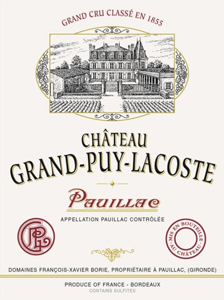

You cannot get more “trad claret” that the 1986 Grand-Puy-Lacoste. From a Pauillac that takes time to reach its drinking plateau and a notorious vintage hellbent on testing the most patient Bordeaux-lover, after 35-years, it is finally waking up the idea that its raison d’être is to give us pleasure. This bottle was poured by the Emeline Borie when I visited the estate last June. It is a vintage that I have tasted three or four times previously, though not for five years. Many prefer to serve the ’82 at the moment, and Vinous readers will see a review of that from both bottle and magnum in the future, as well as a vertical of other vintages. This ’86 showed better than the example I drank five years earlier. Showing little signs of ageing, the nose is quintessential Pauillac with predominantly black fruit, cassis, mint and graphite. The palate is well-balanced, grippy and with a firm backbone, impressive in terms of weight and density. Cedar and tobacco infuse the black fruit and linger on its sapid finish. Whilst it just lacks the élan of the ’82 or perhaps the ’90, this Grand Puy Lacoste is now drinking well, though it deserves a 90-minute decant.
This wine is the finest Grand Puy Lacoste produced after 1990 or 1982 and before 1995. The 1986 still possesses an impressive deep ruby/purple color, as well as a classic nose of cedar, black currants, smoke and vanilla. It is full-bodied, powerful, authoritatively rich, and loaded with fruit, with a solid lashing of tannin not likely to ever totally melt away. This wine can be drunk now, although it is backward and unyielding. Certainly, it is one of the better northern Medocs of the vintage. Anticipated maturity: 2004-2018.
The 1986 Grand-Puy-Lacoste has an intriguing nose, much richer and more opulent than I expected (reminiscent of the 1986 Cos d'Estournel that I tasted earlier the same day.) Whereas the 1996 is strict, this 1986 is much more plush but perhaps does not possess the same delineation. The palate leans more towards the red fruit than black with a sharp tang of a black pepper on the entry, good weight in the mouth, nicely focused with firm grip on the tarry, gutsy finish. You could broach this now of course or drink this over the next 20 years. You could argue that it is "uncouth" compared to recent vintages under Xavier Borie, but it is still certainly worth investigating (if you can find it, since there is nary a bottle left in the château bins!). Tasted July 2016.